


Improved ROM performance
Sampling method & ROM Enhancement/Evaluation

We present the performance improvements of the Real-Time Simulator (ROM) in BARAM v26.1. These include the ability to generate initial sampling conditions, automatically add conditions where errors are high, and check the difference between CFD and ROM results under these added conditions .
Create initial sampling conditions
Previously, sampling conditions had to be imported from a CSV or XLSX file, forcing users to use a separate tool to create Design of Experiments (DOE) sampling conditions. Now, conditions can be created directly in BARAM using three methods: Latin Hypercube Sampling, Sobol, and Full Factorial.
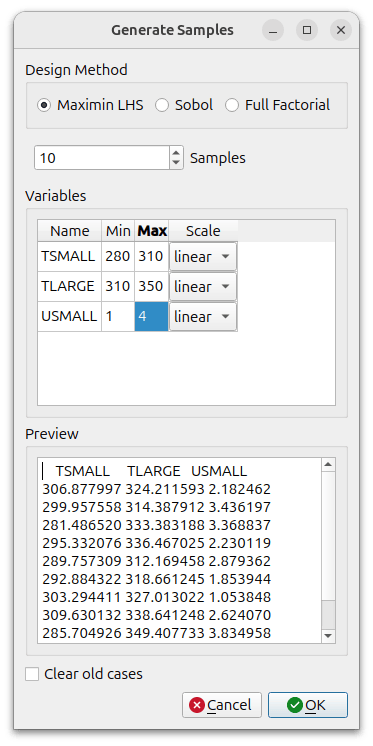
Here are the 30 conditions created using the Latin HyperCube Sampling technique with two variables, angle of attack and speed, from the DARPA Suboff submarine model above:

Added conditions to improve ROM performance
After creating a ROM using initial sampling conditions, when adding conditions to improve accuracy, it’s effective to select points with the highest uncertainty. Simply enter the number of conditions to add in BARAM’s Model Enhancement section, and Gaussian Process Regression (GPR) will automatically generate the optimal conditions.

In the DARPA Suboff submarine problem above, the added positions when the number was set to 10 are as follows:

ROM accuracy assessment
Once the calculation for the added conditions is completed, the difference between the CFD results and the ROM results is displayed for the user-defined values (aerodynamic coefficients, point/surface/volume values). The point/surface/volume values can be set to average, integral, flowrate, min/max, CoV, etc.
CFD calculations for additional conditions are performed according to the following procedure:
- Generate results for new conditions from existing ROMs
- CFD analysis using ROM results as initial conditions
- Update to a new ROM by adding the simulation results to the existing snapshots.
- Error report between existing ROM results and CFD analysis results

The difference in drag coefficient between CFD results and ROM results under the added conditions is as follows.

The calculation of the added condition converges quickly because it uses the ROM results as initial values. The initial calculation required over 300 iterations, but now requires only about 100, achieving convergence in about a third of the time.


